High-Temperature Low-Sag
1. Product Overview
High-Temperature Low-Sag (HTLS) Conductors are designed for overhead transmission applications requiring improved current-carrying capability and controlled sag at elevated operating temperatures. Compared with conventional ACSR conductors, suitable HTLS designs can offer higher operating-temperature capability, reduced thermal sag, and improved utilization of existing transmission corridors. Actual performance depends on conductor design, line conditions, fittings, and approved engineering calculations.
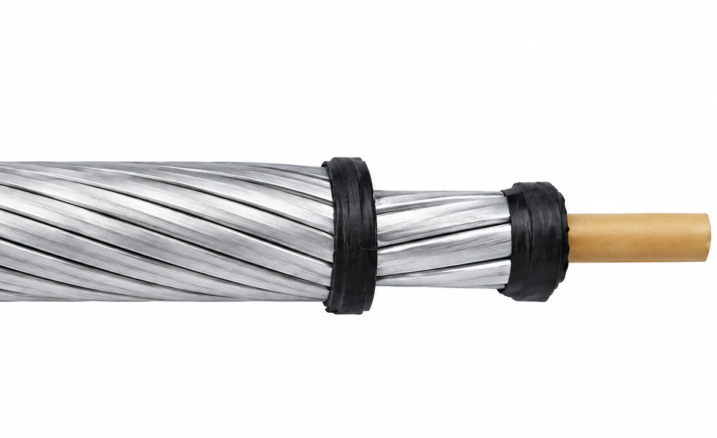
KJV Alloy Conductors Pvt. Ltd. presents HTLS conductor solutions using trapezoidal aluminium wires stranded around a hybrid carbon-and-glass-fibre composite core, as described in the source presentation.
2. Key Features
- High-temperature operation: the source presentation states operation up to 200°C. Confirm the applicable conductor design and rating before publishing this limit.
- Low sag at elevated temperatures, subject to design and installation conditions.
- Composite core construction using hybrid carbon and glass fibre.
- Trapezoidal aluminium wire construction for increased aluminium content in the stated designs.
- Potential for increased current-carrying capacity and reduced electrical losses compared with the referenced conventional conductor designs.
- Lightweight construction in the specific comparisons shown in the technical tables.
3. Construction
The construction described in the presentation comprises fully annealed, trapezoidal-shaped aluminium wires concentrically stranded over a hybrid carbon-and-glass-fibre composite core. The presentation identifies 1350-O tempered aluminium wires and a composite core.
4. Materials and Standards Listed in the Presentation
| Item | Source presentation statement |
| Aluminium wires | 1350-O tempered aluminium wires as per ASTM B609 |
| Composite core | Hybrid carbon and glass-fibre composite core according to ASTM B987 |
| Lay length | Lay-length ratios stated to conform to ASTM B857 |
Standards and material descriptions above are transcribed from the supplied presentation. Confirm the exact standard editions, applicability, and compliance documentation before displaying them as formal product certifications.
5. Technical Comparison: ACSR Drake vs HTLS Drake Design
The following figures are from the source PPT, with ACER Drake renamed “HTLS Drake design” for this draft. These are source-provided comparison values, not independently validated specifications.
| Parameter | ACSR Drake | HTLS Drake design |
| Conductor construction | 26(Al)/4.442 mm + 7(St)/3.454 mm | Annealed Al 14TW + annealed Al 8TW + composite core 1/9.53 mm |
| Total conductor cross-sectional area (mm²) | 469 | 591 |
| Aluminium cross-sectional area (mm²) | 402.8 | 519.7 |
| Core cross-sectional area (mm²) | 65.464 | 71.3 |
| Conductor diameter (mm) | 28.14 | 28.14 |
| Core diameter (mm) | 17.78 | 9.53 |
| Conductor mass (kg/km) | 1624 | 1565.6 |
| DC resistance (Ω/km) at stated 200°C condition | 0.0715 | 0.0526 |
| Rated conductor strength (kN) | 139.05 | 180.6 |
| Rated core strength (kN) | — | 153.8 |
| Current capacity at 85°C (A) | 755.51 | 792 |
| Current capacity at 180°C (A) | Not stated / N.A. | 1593 |
6. Technical Comparison: ACSR Panther vs HTLS Casablanca Designs
| Parameter | ACSR Panther | HTLS Casablanca | HTLS Casablanca Plus |
| Conductor construction | 30(Al)/3.00 mm + 7(St)/3.00 mm | Annealed Al 12TW + annealed Al 8TW + composite core 1/7.11 mm | Annealed Al 10TW + annealed Al 6TW + composite core 1/7.11 mm |
| Total conductor cross-sectional area (mm²) | 261.5 | 313.3 | 332.7 |
| Aluminium cross-sectional area (mm²) | 211.95 | 273.6 | 293 |
| Core cross-sectional area (mm²) | 49.46 | 39.7 | 39.7 |
| Conductor diameter (mm) | 21 | 20.5 | 21 |
| Core diameter (mm) | 9 | 7.11 | 7.11 |
| Conductor mass (kg/km) | 974 | 832 | 882.9 |
| DC resistance (Ω/km), condition stated as 200°C | 0.1390 | 0.1024 | 0.0954 |
| Rated conductor strength (kN) | 89.67 | 100.4 | 101.9 |
| Rated core strength (kN) | — | 85 | 85 |
| Current capacity at 85°C (A) | 486 | 539 | 572 |
| Current capacity at 180°C (A) | Not stated / N.A. | 1050 | 1094 |
Important data check: the original slide repeats “Rated Strength of Core” on two consecutive rows, with the first row containing values that appear to correspond to conductor strength. The table above labels the first row “Rated conductor strength” based on the preceding slide’s row sequence; confirm against the approved datasheet before publishing.
7. HTLS vs ACSR: General Comparison
| Feature | HTLS conductor (design-dependent) | Conventional ACSR |
| Core material | May use a composite core such as carbon/glass fibre | Steel core |
| Thermal performance | Designed for higher operating temperatures in applicable designs | Typically more limited by conventional design and allowable temperature |
| Sag at elevated temperature | Can provide lower thermal sag for suitable designs | Sag generally increases with conductor temperature |
| Weight | Can be lower in some comparable designs | Depends on conductor size and steel content |
| Current capacity | Can be higher for a specified design and operating condition | Depends on conductor design and allowable operating temperature |
| Corrosion | Composite core avoids steel-core corrosion; aluminium and fittings still require consideration | Steel core may require corrosion protection and suitable handling |
| Cost | May have a higher initial conductor cost; evaluate lifecycle and reconductoring economics | Often lower initial conductor cost |
| Typical application | Transmission capacity uprating and high-temperature overhead-line applications | Conventional overhead transmission and distribution |
Avoid absolute claims such as “highest conductivity” or “lowest sag in the HTLS category” unless supported by a defined benchmark, test data, and a specific conductor design.
9. Type-Test Information Listed in the Presentation
| Test / report description | Report number and date shown | Agency shown |
| RIV test | GPRI/EN/KIL/070 dated 19.09.2025 | Global Power Research Institute, Tamil Nadu (name spelling to be confirmed) |
| Corona inception/extinction voltage test | GPRI/EN/KIL/070 dated 19.09.2025 | Global Power Research Institute, Tamil Nadu (name spelling to be confirmed) |
| HTLS type test | K-850210-RP-0002 R00; K-850210-RP-0001 R01; K-850210-RP-0003 R00, dated 14.10.2025 | Kinectrics India Private Limited |
Before publishing, verify report titles, report numbers, dates, laboratory’s official name, scope, and whether each report applies to the exact conductor design being advertised. Do not present a report reference as a certification unless the report supports that wording.

AACSR Conductor

AACSR Conductor

AACSR Conductor

ACSR Conductor

AAAC Conductor