
High-Temperature Low-Sag
- Overview
HTLS® conductors are “High-Temperature Low-Sag” (HTLS) conductors with excellent electrical characteristics, excellent sag-tension characteristics and superior corrosion resistance compared to ACSR. Compared with ACSR they offer lighter weight, comparable strength and current carrying capacity, lower electrical losses and superior corrosion resistance. These qualities have given the conductor wide acceptance as a transmission conductor. It has found limited use as a distribution conductor.
A breakthrough conductor enabling cost-effective voltage upgrades, HTLS maximizes corridor efficiency, reduces losses, and enhances transmission capacity with an advanced composite core and optimized aluminum design.
- Construction
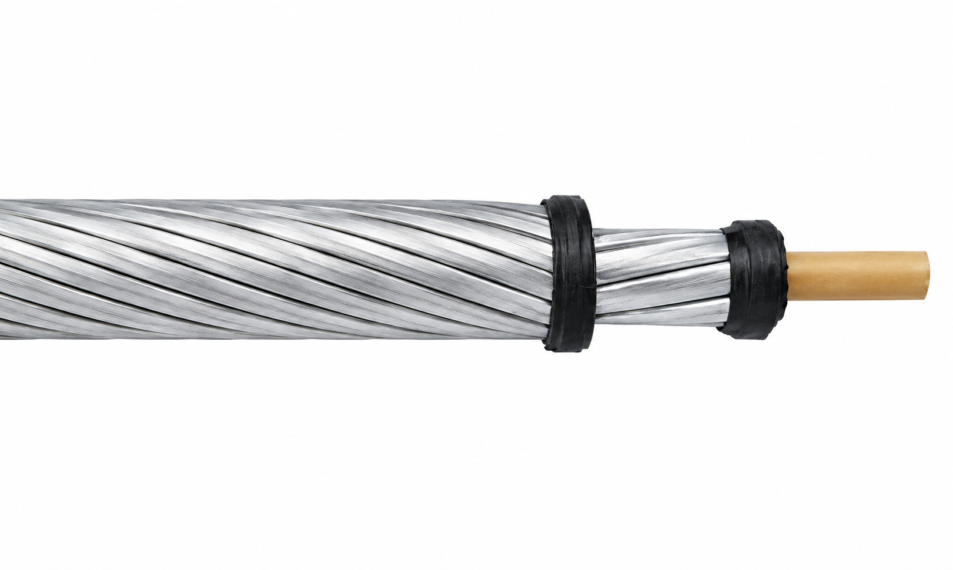
Fully annealed trapezoidal-shaped aluminium wires are concentrically stranded over a hybrid carbon and glass fiber core (Composite Core).
- Outer layer: 1350-O tempered (fully annealed) trapezoidal aluminum wires
- Core: Hybrid carbon and glass fiber composite core
- Surface finish: Available with non-specular (dull) finish and color coated as per customized requirements
- Governing Standards
- 1350-O tempered aluminum wires as per ASTM B 609 or EN 50540
- Hybrid carbon and glass fiber core (Composite Core) according to ASTM B987
- HTLS® conductors must exhibit lay lengths (ratios) that conform to ASTM B 857 or EN 50540
- Applicable standards for HTLS Casablanca (Plus): B609, B857, B987 (ASTM); BS EN 50540; IEC 62219
- Key Features
- Can be operated up to 180°C
- Lowest sag among the HTLS category, due to the lowest coefficient of thermal expansion and higher strength-to-weight ratio
- Highest conductivity conductor
- Applications
- Renewable energy transmission
- Upgrading of sub-transmission and distribution lines
- Transmission line uprating and reconductoring on existing corridors
- Technical Specifications: HTLS Casablanca (Plus), 657 kcmil
| Parameter | Metric | Imperial |
| Total sectional area | 332.7 mm² | 0.5157 in² |
| Aluminum sectional area | 293 mm² | 0.4541 in² |
| Composite core sectional area | 39.7 mm² | 0.0615 in² |
| No. of aluminum wires | 16 nos. | 16 nos. |
| No. of composite core and diameter | 1 × 7.11 mm | 1 × 0.2799 in |
| Overall diameter | 21.0 mm | 0.8268 in |
| Weight | 0.883 kg/m | 0.5934 lb/ft |
| Rated strength of conductor | 101.9 kN | 22908 lbs |
| Rated strength of core | 85 kN | 19109 lbs |
| DC resistance at 20°C (68°F) | 0.0954 Ω/km | 0.1535 Ω/mile |
| Current capacity at 180°C (356°F) | 1220 A | 1220 A |
| Current capacity at 200°C (392°F) | 1285 A | 1285 A |
| Max. operating temperature | 180°C | 356°F |
| Direction of lay | Right hand | Right hand |
| Coefficient of thermal expansion | 18.55 × 10⁻⁶ /°C | 10.31 × 10⁻⁶ /°F |
| Final modulus of elasticity | 64.48 GPa | 9352 ksi |
Note: Current capacity is based on referenced conductor temperature, 0.6 m/s (2 ft/s) wind, 0 m (0 ft) elevation, 0.5 emissivity, 0.5 absorptivity, 25°C (77°F) ambient temperature, 1033 W/m² (96 W/ft²) solar radiation.
- HTLS vs. Conventional ACSR: Summary
| Aspect | HTLS | ACSR |
| Weight | Lighter | Heavier |
| Strength | Comparable or better | Baseline |
| Current capacity | Higher (operates up to 180°C) | Lower |
| Electrical losses | Lower (up to ~30% less) | Higher |
| Sag at high temperature | Lowest among HTLS | Higher |
| Corrosion resistance | Superior | Prone to galvanic corrosion |